
Learn, Pool Cues Guide
Carbon Fiber vs Wood Pool Cues: Which is Right for You in 2026?
The debate between carbon fiber and wood pool cue shafts has intensified over the past few years as carbon fiber technology has become more accessible. Both materials have genuine merits, and the right choice depends heavily on your playing style, skill level, environment, and personal preferences. This guide cuts through the marketing noise to give you an honest, data-driven comparison.
The Core Difference: Material Science in Billiards
To understand why these two materials play differently, you need to understand the physics at work when a cue strikes a ball.
When your cue contacts the cue ball, two things happen simultaneously: energy transfers from the cue to the ball (power), and the shaft flexes slightly then returns to straight (deflection). The material properties of the shaft directly determine how much deflection occurs and how that deflection affects cue ball direction.
Wood Shaft Characteristics
Wood is an organic material with variable grain structure, moisture content, and density even within the same species. Premium cue makers like Rhino select and season their wood carefully to minimize these variations, but wood can never achieve the consistency of an engineered material.
Key wood characteristics:
- Natural grain structure creates slight inconsistency between individual shafts
- Responds to humidity changes by expanding and contracting (causing warp risk)
- Higher deflection than carbon fiber at equivalent stiffness levels
- Unique tactile feedback that many experienced players prefer
- Can be reshaped, refinished, and repaired
- Traditional aesthetic that resonates with the history of billiards
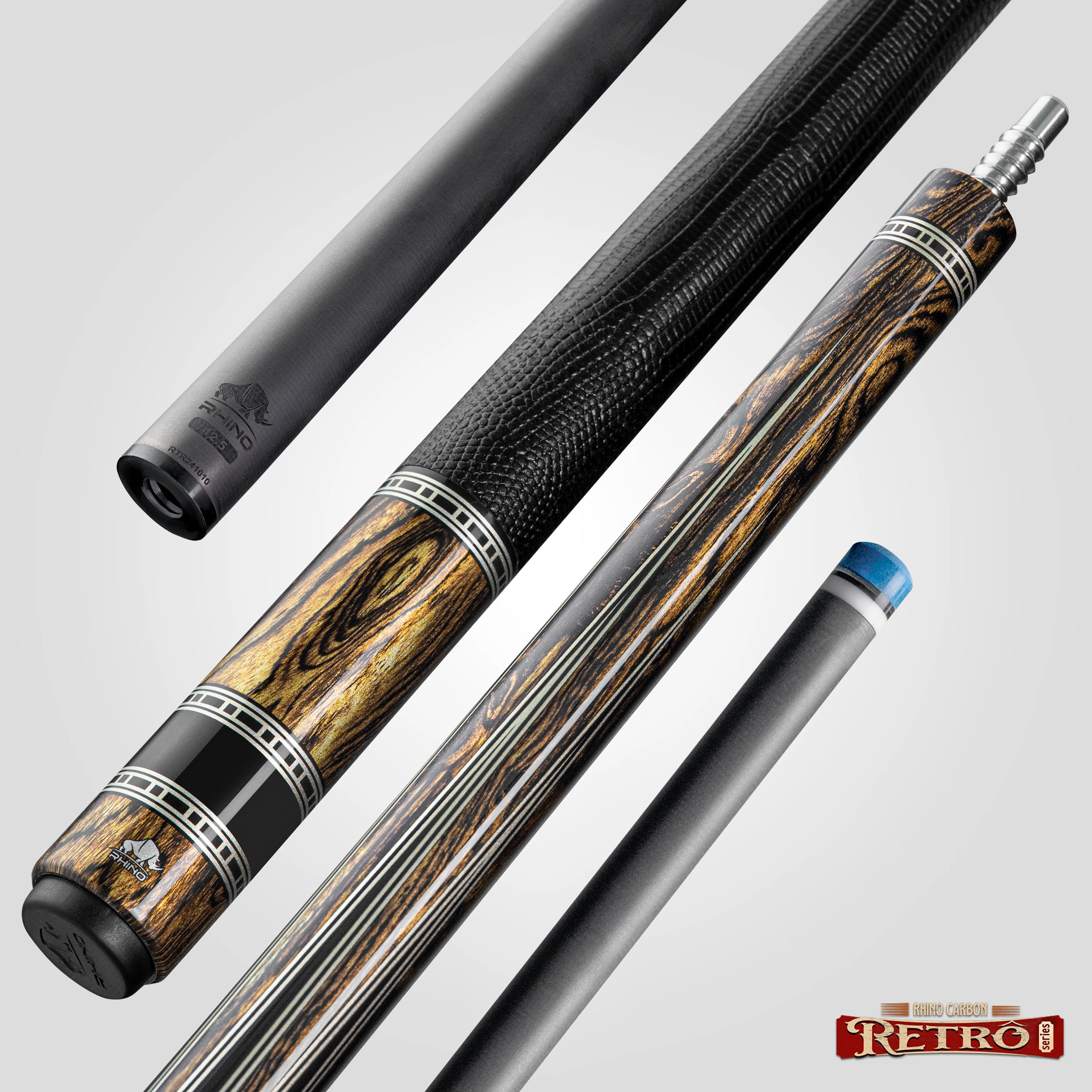
The Rhino RETRÔ Cocobolo and other exotic wood cues represent the pinnacle of wood shaft craftsmanship — each piece carefully selected to minimize the natural inconsistencies of the material.
Carbon Fiber Shaft Characteristics
Carbon fiber is an engineered composite material with properties that engineers design rather than nature providing. Every carbon fiber shaft from the same production batch has virtually identical characteristics.
Key carbon fiber characteristics:
- Extremely consistent performance across all shafts
- Complete immunity to humidity and temperature changes
- Significantly lower deflection than equivalent wood shafts
- Higher stiffness-to-weight ratio than wood
- Requires no maintenance (no warping, no grain treatment)
- Cannot be repaired if cracked; must be replaced
- Modern aesthetic that some players love, others find impersonal
The Nebula 2 exemplifies the modern carbon fiber approach: consistent, performance-optimized, and maintenance-free.
Head-to-Head Performance Comparison
Deflection and English Control
Carbon Fiber Wins
This is carbon fiber’s most significant advantage. Low-deflection shafts allow you to apply heavy English (side spin) with minimal compensation in your aiming. In practical terms: if you aim at a ball and apply left English, the cue ball curves slightly left as it travels. With a high-deflection wood shaft, you’d need to aim slightly right to compensate. With a low-deflection carbon shaft, that compensation is minimal.
For players who use heavy English in their positional game, this difference is substantial. Many players who switch to carbon fiber report their English game improving dramatically within weeks.
Break Shot Power
Carbon Fiber Wins (Marginal Advantage)
Carbon fiber’s stiffness means less energy is absorbed by shaft flex during a break shot. In practice, this translates to slightly more cue ball speed at contact, which produces more ball spread. The Rhino Carbon Fiber Break Shaft demonstrates this principle well — even on existing wood cue butts, the carbon shaft measurably improves break performance.
That said, a player with excellent break technique using a quality wood break cue like the Rhino VOYAGER USA Break Cue will outperform a novice with a carbon fiber cue every time. Technique matters more than material at all but the elite competitive level.
Draw and Stop Shots
Essentially Equal
Draw and stop shots depend primarily on tip contact quality and cue ball speed control. Both wood and carbon shafts can produce excellent draw shots in skilled hands. Some players actually prefer wood for draw shots because the shaft flex provides slight additional dwell time at contact, making extreme draw shots feel more controlled.
Soft Touch and Positional Play
Wood Has a Slight Edge for Feel
Delicate touch shots — gently rolling the cue ball to a specific position, playing soft safeties — require precise speed control. Wood’s natural flex provides sensory feedback that many experienced players rely on for this calibration. Carbon fiber’s rigidity can initially make soft shots feel dead or over-powered.
This is largely an adaptation issue rather than a physical limitation. Players who learn on carbon fiber from the beginning don’t experience this as a problem. But veteran players switching from wood often need a few months before their soft game feels as confident.
Consistency Across Sessions
Carbon Fiber Wins Decisively
A wood shaft plays differently on a cold dry January evening versus a hot humid August afternoon. The shaft responds to environmental conditions constantly. Players who compete in tournaments across different climate regions particularly notice this.
Carbon fiber is completely inert to temperature and humidity. Your cue plays identically at all times, in all conditions. For competitive players, this consistency is invaluable.
Durability
Carbon Fiber Wins
Wood shafts warp, develop dead spots, and require periodic replacement (every 3-5 years for active players). Carbon fiber shafts maintain their performance essentially indefinitely under normal playing conditions. The only way to damage a carbon fiber shaft is physical impact — dropping it hard or striking it against something can crack the fibers.
Aesthetic and Tradition
Wood Wins
There is no carbon fiber cue that captures the visual warmth of a well-crafted Rhino Thuya or the striking grain of a Snake wood cue. Wood’s connection to billiards history and its natural beauty is something carbon fiber simply cannot replicate.
Players who love the game’s traditions, the craftsmanship of exotic woods, and the personal relationship with a well-maintained cue will always have reasons to choose wood.
The Learning Curve: Switching Between Materials
Switching from a wood shaft to carbon fiber requires genuine adjustment time, and this is often underestimated. Here is what to expect:
Week 1-2: Shots that felt automatic now require conscious aim adjustment. English shots especially may feel off as your muscle memory compensates for deflection that no longer exists.
Week 3-4: The new aim points start feeling more natural. Break shots improve noticeably as you learn to drive through the ball confidently.
Month 2: Most players reach parity with their previous performance on wood and begin experiencing carbon fiber’s advantages.
Month 3+: English control and tournament consistency improvements become fully apparent. Most players who make this transition report not wanting to go back.
Switching from carbon fiber back to wood has the opposite problem — suddenly a high-deflection shaft creates shots that pull in unexpected directions. The adjustment period is similar in length.
Which Players Should Choose Carbon Fiber?
- Players who compete in tournaments across multiple climate regions
- Players whose English game is limiting their progress
- Players who are still developing their game and want a consistent baseline
- Players who want low maintenance equipment
- Anyone who plays in humid environments or stores their cue in temperature-variable locations
The Nebula 2 is the recommended starting point for most players making this switch.
Which Players Should Choose Wood?
- Players with decades of experience who have mastered wood shaft aim compensation
- Players for whom the aesthetic and tradition of billiards matters deeply
- Players whose game relies heavily on soft touch and delicate speed control
- Collectors who appreciate handcrafted exotic wood cues as objects of beauty
- Players who play primarily indoors in climate-controlled environments
The Rhino RETRÔ series represents the best of what wood craftsmanship can offer.
The Practical Solution: Own Both
Many competitive players have arrived at the same conclusion: own a carbon fiber playing cue for tournaments and a beautiful wood cue for regular play and practice. This gives you the best of both worlds — the consistency you need when results matter, and the playing experience you love during casual games.
At Arjumany, this combination is accessible without requiring a massive investment. The Nebula 2 carbon fiber cue paired with a Rhino RETRÔ wood cue gives you a complete two-cue setup that covers every playing scenario.
Frequently Asked Questions
Is there a performance difference between cheap and expensive carbon fiber cues?
Yes, but less than with wood. The basic physical advantages of carbon fiber (low deflection, warp resistance) are present in even budget carbon shafts. The differences between mid-range and premium carbon shafts are primarily in joint tolerances, ferrule quality, and tip-to-shaft energy transfer efficiency. For most players, mid-range carbon fiber like the Nebula 2 hits the optimal performance-to-value point.
Do professional players use carbon fiber?
An increasing number do. Carbon fiber has grown significantly in professional billiards adoption over the past five years. Players who grew up with wood shafts and built their games around wood deflection characteristics are slower to switch, but younger professionals entering the sport often choose carbon fiber from the start.
Can I put a carbon fiber shaft on my existing wood cue?
Potentially yes, if the joint specifications match. The Rhino Carbon Fiber Break Shaft is specifically designed to fit standard joint systems on existing cues. For playing shafts, you would need to verify joint compatibility between your butt and a carbon fiber shaft.
Which is better for a beginner?
Carbon fiber actually has some advantages for beginners: the consistent low deflection means there is one less variable to manage as you develop your stroke. However, many instructors teach on wood shafts because most available cues (including house cues) are wood, and beginners need to develop adaptability. Either material works for learning; consistency of practice matters more than shaft material for new players.
The Bottom Line
Carbon fiber wins on objective performance metrics: less deflection, more consistency, lower maintenance, better durability. Wood wins on feel, tradition, and aesthetics.
For most active players in 2026, the practical recommendation is: try carbon fiber. The Nebula 2 makes this trial accessible without a major financial commitment. If you find it improves your game and the consistency appeals to you, you have found your tournament cue. If you miss the wood feel, the Rhino RETRÔ line will be waiting.
Explore both options at Arjumany’s pool cue shop.